SCENARIO ATLAS · TMO CORE

Real projects. Recognisable business processes.

Discover five businesses in the CORE ecosystem, then explore the sales, bookings, stock and handovers behind the work.

Project websites are public. Walkthroughs are illustrative examples of work through OPS and CORE; documented results are identified separately.

PROJECT SHOWCASE

Five businesses. Five concrete starting points.

Visit the public websites and follow a practical workflow illustration for each project.

01Retail & marketplace

Vintage Design Center

One object, from showroom to collection.

A physical design destination and online marketplace connecting independent sellers, objects and buyers.

TMO CORE

Keep the object, seller, agreed sale and collection record together.

Visit the project vintagedesigncenter.com
Follow an example workflow

Workflow illustration

  1. 01

    A buyer scans a showroom label or asks about an online object.

  2. 02

    The operator reviews the object file, seller, condition and availability.

  3. 03

    The seller or authorised operator confirms the price and collection conditions.

  4. 04

    The sale and collection plan refer to the same object and agreed conditions.

NUMA OPS

Help the operator find the object, answer the buyer and prepare the next step.

See the other side of the story


02Automotive & private sales

Scuderia Milano

The vehicle file behind a private introduction.

Private automotive consultancy, selected catalogues, provenance research and specialist coordination.

TMO CORE

Connect a vehicle file, catalogue access, offer and agreed handover.

Visit the project scuderia-milano.com
Follow an example workflow

Workflow illustration

  1. 01

    A collector asks about a vehicle or requests access to a selected catalogue.

  2. 02

    The consultant assembles the relevant history, images and disclosure instructions.

  3. 03

    The owner or authorised specialist decides which details and next steps may be shared.

  4. 04

    The selected introduction, offer and handover remain connected to the vehicle file.

NUMA OPS

Bring the enquiry, documents and owner instructions into the consultant’s working context.

See the other side of the story
03Consultancy & digital delivery

CSM Associates / CSM LABS

From a first brief to agreed delivery.

Commercial consultancy and digital projects, from websites and customer journeys to implementation and growth.

TMO CORE

Keep the engagement scope, responsibilities, milestones and approved changes together.

Visit the project csmconsultancy.com
Follow an example workflow

Workflow illustration

  1. 01

    A business shares a website, launch or commercial problem.

  2. 02

    The consultant brings the brief, source material, meetings and proposal together.

  3. 03

    Client and consultant agree the scope, responsibilities and next milestone.

  4. 04

    Delivery and subsequent changes can be reviewed against the agreed engagement.

NUMA OPS

Turn messages and meetings into a usable brief, proposal and follow-up.

See the other side of the story

04Hospitality & direct discovery

Overnightstay

From finding a stay to preparing an arrival.

An accommodation directory for Flanders that helps guests find and contact providers directly.

TMO CORE

Illustrate how dates, room availability, reservation conditions and staff handovers can stay connected.

Visit the project overnightstay.be
Follow an example workflow

Workflow illustration

  1. 01

    A guest discovers an accommodation and contacts the provider directly.

  2. 02

    The host reviews the requested dates, room requirements and practical questions.

  3. 03

    The host and guest confirm the reservation and applicable conditions.

  4. 04

    A hospitality workflow connects the confirmed stay to room preparation and arrival.

NUMA OPS

Help a host bring the guest request, preparation tasks and arrival changes into one working view.

See the other side of the story

05Executive experiences & events

The Race Within

A considered application. A coordinated experience.

A proposed human-performance programme for leaders, built around racing intelligence, private hospitality and follow-up.

TMO CORE

Illustrate how participant places, agreed inclusions, partners and programme changes can stay connected.

Visit the project race-within.com
Follow an example workflow

Workflow illustration

  1. 01

    A leader expresses interest in a proposed retreat or private programme.

  2. 02

    The organiser prepares the fit conversation, programme outline and practical requirements.

  3. 03

    The participant and organiser agree the place, inclusions and responsibilities.

  4. 04

    The agreed programme guides partner coordination, arrival and subsequent follow-up.

NUMA OPS

Help the organiser prepare enquiries, itineraries, partner tasks and participant follow-up.

See the other side of the story
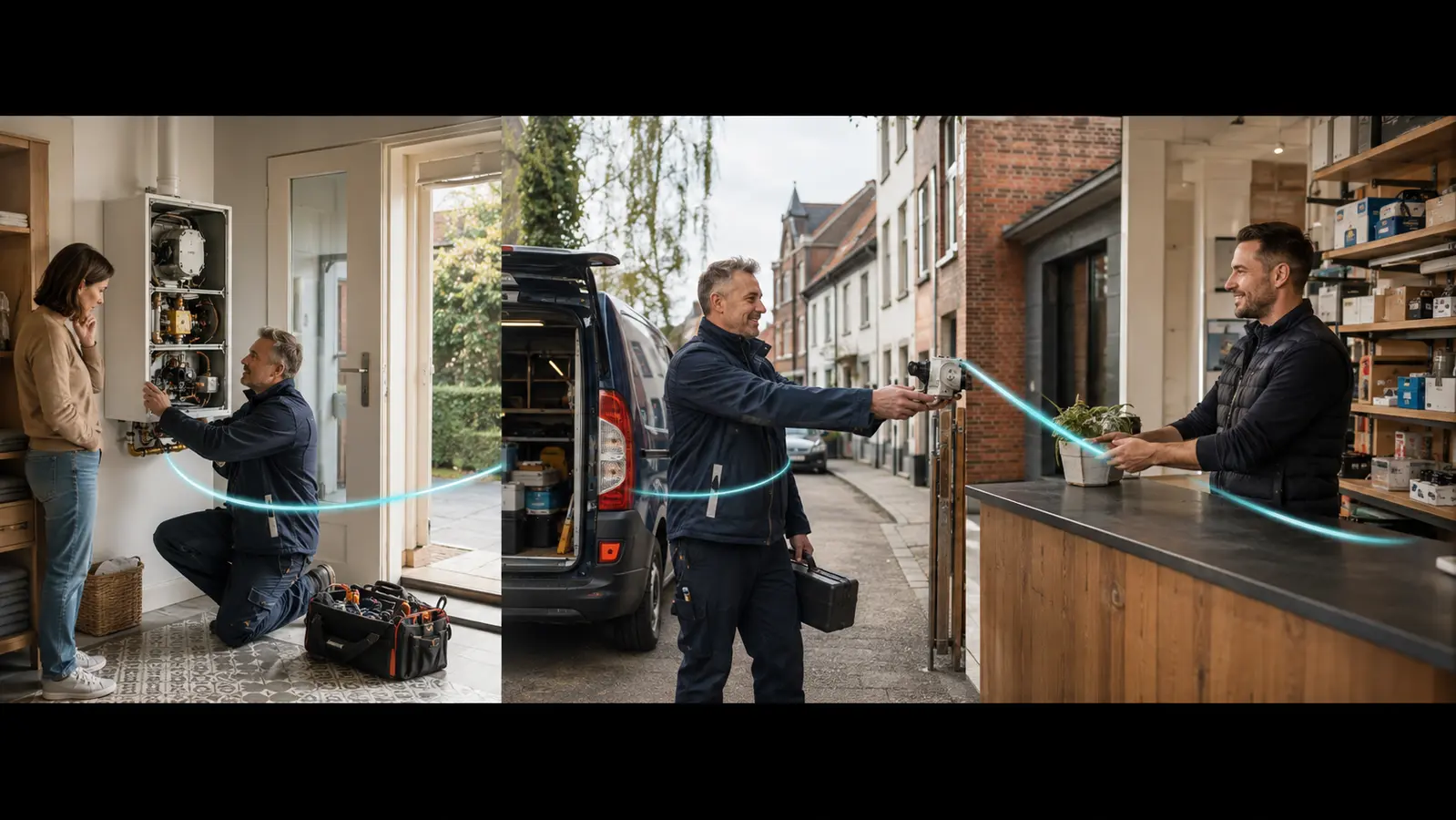
THE ORIGINAL ATLASBrowse all 42 workflow examplesChoose a situation and follow the seven steps.
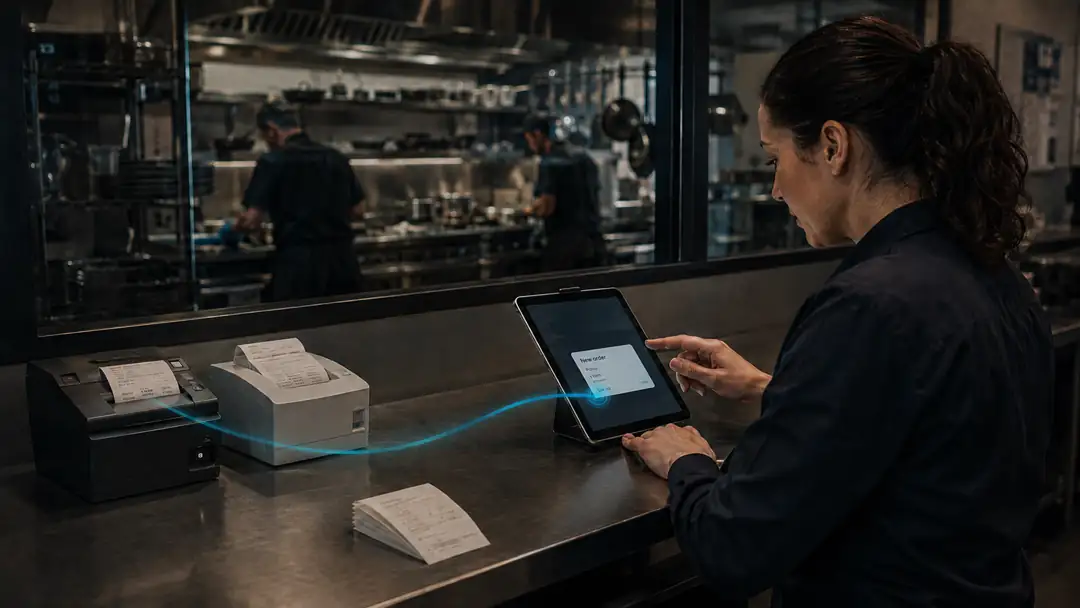
Retail & POSCompletes a sale in OPS Point of Sale.Checks price, stock, benefit and payment.Explore the steps
Illustration for: Completes a sale in OPS Point of Sale.
Illustrative scene

Person doing the work: Store operator

  1. Signal

    Completes a sale in OPS Point of Sale.

  2. OPS context

    Checks price, stock, benefit and payment.

  3. Human authority

    The store operator verifies the scanned item, displayed price, payment result and fulfilment choice before confirming the sale.

  4. Bounded handoff

    Only the approved buyer, seller, item, price and fulfilment payload leaves OPS for CORE.

  5. CORE record

    Binds buyer, seller, item and conditions.

  6. Shared consequence

    Stock, payment and fulfilment move together.

  7. Durable evidence

    The receipt preserves the price version, payment reference, stock unit and fulfilment promise that applied at checkout.

Intended result

Stock, payment and fulfilment move together.

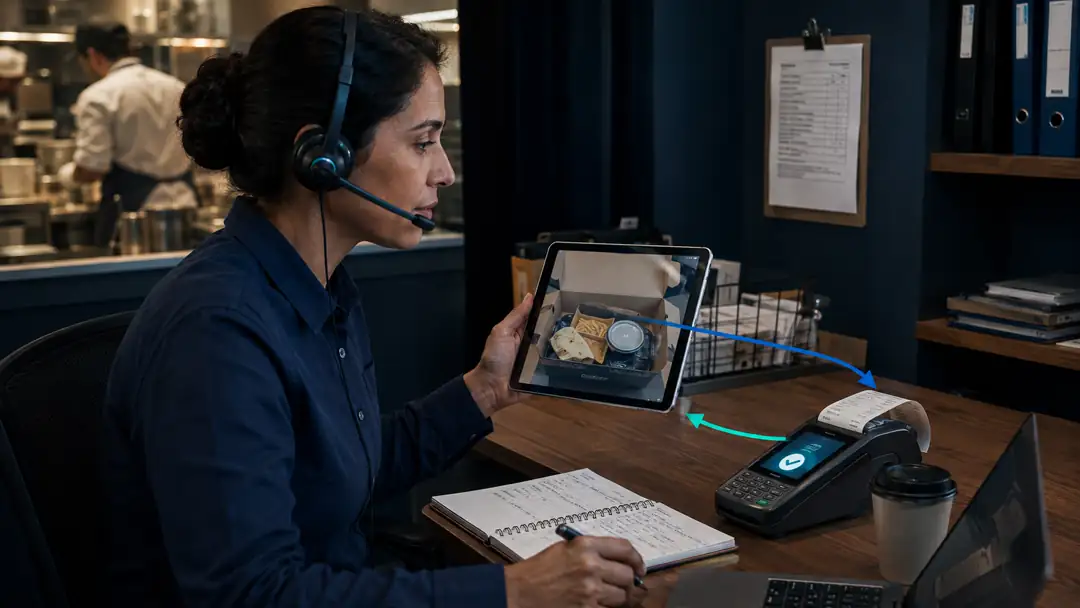
Retail & POSReturns an earlier purchase.Finds receipt and records product condition.Explore the steps
Illustration for: Returns an earlier purchase.
Illustrative scene

Person doing the work: Customer

  1. Signal

    Returns an earlier purchase.

  2. OPS context

    Finds receipt and records product condition.

  3. Human authority

    Customer service confirms the original receipt, return window, item condition and refund route before accepting the return.

  4. Bounded handoff

    OPS sends the original sale reference, inspected condition and approved correction amount; unrelated customer history stays private.

  5. CORE record

    Links a correction to the original sale.

  6. Shared consequence

    Stock, tax and refund stay explainable.

  7. Durable evidence

    The return record links inspection, stock disposition, tax correction and refund to the sale it reverses.

Intended result

Stock, tax and refund stay explainable.

Retail & POSChanges a temporary store price.Checks authority and validity window.Explore the steps
Illustration for: Changes a temporary store price.
Illustrative scene

Person doing the work: Store manager

  1. Signal

    Changes a temporary store price.

  2. OPS context

    Checks authority and validity window.

  3. Human authority

    The store manager confirms scope, start time, end time and affected assortment before the temporary price can take effect.

  4. Bounded handoff

    Only the authorised price rule and validity window cross into CORE; drafts and internal margin notes remain in OPS.

  5. CORE record

    Versions the price rule.

  6. Shared consequence

    Old and new sales retain their own truth.

  7. Durable evidence

    Each sale keeps the exact price version, authority and effective time used when the basket was confirmed.

Intended result

Old and new sales retain their own truth.

Retail & POSPublishes an assortment to selected channels.Manages products, variants, media and channels.Explore the steps
Illustration for: Publishes an assortment to selected channels.
Illustrative scene

Person doing the work: Claudia Collections

  1. Signal

    Publishes an assortment to selected channels.

  2. OPS context

    Manages products, variants, media and channels.

  3. Human authority

    Claudia Collections approves the selected products, variants, media, channel rights and publication window as one assortment release.

  4. Bounded handoff

    CORE receives the canonical offers and channel conditions, never unpublished creative work or internal catalogue notes.

  5. CORE record

    Creates canonical offers and channel conditions.

  6. Shared consequence

    One assortment can sell without losing brand identity.

  7. Durable evidence

    The publication evidence binds every channel listing to its source product, media version, owner and approved conditions.

Intended result

One assortment can sell without losing brand identity.

Retail & POSSells a CORE product in an owned webshop.Receives the order through the connector.Explore the steps
Illustration for: Sells a CORE product in an owned webshop.
Illustrative scene

Person doing the work: Marketplace seller

  1. Signal

    Sells a CORE product in an owned webshop.

  2. OPS context

    Receives the order through the connector.

  3. Human authority

    The seller confirms the order, valid channel offer, stock source and commercial split before fulfilment begins.

  4. Bounded handoff

    OPS hands CORE the approved order and channel attribution; private webshop behaviour and unrelated customer data do not cross.

  5. CORE record

    Verifies offer, seller, price right and split.

  6. Shared consequence

    Stock and settlement recognise the channel sale.

  7. Durable evidence

    The channel-sale receipt keeps offer version, seller, source channel, stock allocation and settlement position together.

Intended result

Stock and settlement recognise the channel sale.

Retail & POSUses an earned benefit at checkout.Resolves the chosen membership or loyalty right without exposing a saleable profile.Explore the steps
Illustration for: Uses an earned benefit at checkout.
Illustrative scene

Person doing the work: Returning customer

  1. Signal

    Uses an earned benefit at checkout.

  2. OPS context

    Resolves the chosen membership or loyalty right without exposing a saleable profile.

  3. Human authority

    The returning customer chooses the benefit and confirms its one-time use before the checkout total changes.

  4. Bounded handoff

    Only the entitlement identifier, permitted value and consumption decision cross to CORE; the wider customer profile does not.

  5. CORE record

    Validates entitlement, value and one-time consumption.

  6. Shared consequence

    The customer receives the benefit and every channel sees the remaining right.

  7. Durable evidence

    Evidence shows the right before use, the checkout that consumed it and the remaining entitlement visible to other channels.

Intended result

The customer receives the benefit and every channel sees the remaining right.

Food & DeliveryOrders through LemmeEat, a restaurant or city page.Shows menu, choices, slot and delivery.Explore the steps
Illustration for: Orders through LemmeEat, a restaurant or city page.
Illustrative scene

Person doing the work: Guest

  1. Signal

    Orders through LemmeEat, a restaurant or city page.

  2. OPS context

    Shows menu, choices, slot and delivery.

  3. Human authority

    The guest confirms restaurant, items, choices, slot, destination and final price before placing the food order.

  4. Bounded handoff

    OPS transfers the executable kitchen order and fulfilment promise, not the guest conversation or unrelated preferences.

  5. CORE record

    Binds choice, restaurant, price and promise.

  6. Shared consequence

    Kitchen receives one executable order.

  7. Durable evidence

    The order evidence fixes menu version, choices, price, promise time, restaurant and ordering channel.

Intended result

Kitchen receives one executable order.

Food & DeliveryAccepts the order and gives a preparation time.Updates kitchen and relevant channels.Explore the steps
Illustration for: Accepts the order and gives a preparation time.
Illustrative scene

Person doing the work: Restaurant

  1. Signal

    Accepts the order and gives a preparation time.

  2. OPS context

    Updates kitchen and relevant channels.

  3. Human authority

    The restaurant accepts the exact order and commits a preparation time after checking kitchen capacity and exceptions.

  4. Bounded handoff

    CORE receives the acceptance and revised promise time; internal station planning and staff notes remain inside OPS.

  5. CORE record

    Records the new fulfilment promise.

  6. Shared consequence

    Customer and courier share one timeline.

  7. Durable evidence

    The timeline preserves who accepted, when the promise changed and which customer and courier views were updated.

Intended result

Customer and courier share one timeline.

Food & DeliverySends an order into OPS through a connector.Normalises the external order for one kitchen flow.Explore the steps
Illustration for: Sends an order into OPS through a connector.
Illustrative scene

Person doing the work: Deliveroo channel

  1. Signal

    Sends an order into OPS through a connector.

  2. OPS context

    Normalises the external order for one kitchen flow.

  3. Human authority

    The restaurant operator verifies the external order, channel terms, menu mapping and promised service before ingestion.

  4. Bounded handoff

    OPS normalises only the executable order and commercial attribution for CORE; external tracking noise is discarded.

  5. CORE record

    Records channel conditions and commercial consequence.

  6. Shared consequence

    Kitchen works centrally; commission remains visible.

  7. Durable evidence

    Evidence connects the source-channel message to the internal order, menu version, commission rule and acknowledgement.

Intended result

Kitchen works centrally; commission remains visible.

Food & DeliveryScans the order at pickup.Checks package, time and destination.Explore the steps
Illustration for: Scans the order at pickup.
Illustrative scene

Person doing the work: Courier

  1. Signal

    Scans the order at pickup.

  2. OPS context

    Checks package, time and destination.

  3. Human authority

    The courier and restaurant confirm package identity, seal, pickup time and destination before custody changes.

  4. Bounded handoff

    Only the approved package, route commitment and custody handoff cross to CORE; kitchen operations stay local.

  5. CORE record

    Moves commercial custody to the courier.

  6. Shared consequence

    Delay or damage belongs to the correct moment.

  7. Durable evidence

    The pickup record preserves both parties, scan, seal state, time and the exact point at which responsibility moved.

Intended result

Delay or damage belongs to the correct moment.

Food & DeliveryApproves compensation after incomplete delivery.Collects evidence and contact history.Explore the steps
Illustration for: Approves compensation after incomplete delivery.
Illustrative scene

Person doing the work: Customer service

  1. Signal

    Approves compensation after incomplete delivery.

  2. OPS context

    Collects evidence and contact history.

  3. Human authority

    Customer service reviews missing items, delivery evidence, contact history and compensation limits before approving an adjustment.

  4. Bounded handoff

    OPS sends the approved correction and affected order lines to CORE; private support conversation remains behind the boundary.

  5. CORE record

    Posts a linked correction without erasing history.

  6. Shared consequence

    Refund and settlement adjust together.

  7. Durable evidence

    The correction evidence links reason, reviewer, amount, refund, restaurant position and courier consequence to the original order.

Intended result

Refund and settlement adjust together.

HospitalityBooks through Overnightstay or direct.Shows capacity, room rules and extras.Explore the steps
Illustration for: Books through Overnightstay or direct.
Illustrative scene

Person doing the work: Guest

  1. Signal

    Books through Overnightstay or direct.

  2. OPS context

    Shows capacity, room rules and extras.

  3. Human authority

    The guest confirms room, dates, occupants, extras, cancellation terms and total before the stay is booked.

  4. Bounded handoff

    OPS hands CORE the approved reservation and capacity claim; browsing history and unchosen alternatives remain private.

  5. CORE record

    Reserves the offer with price and conditions.

  6. Shared consequence

    The same capacity cannot be promised twice.

  7. Durable evidence

    The booking receipt preserves channel, room type, capacity unit, rate version, terms and payment position.

Intended result

The same capacity cannot be promised twice.

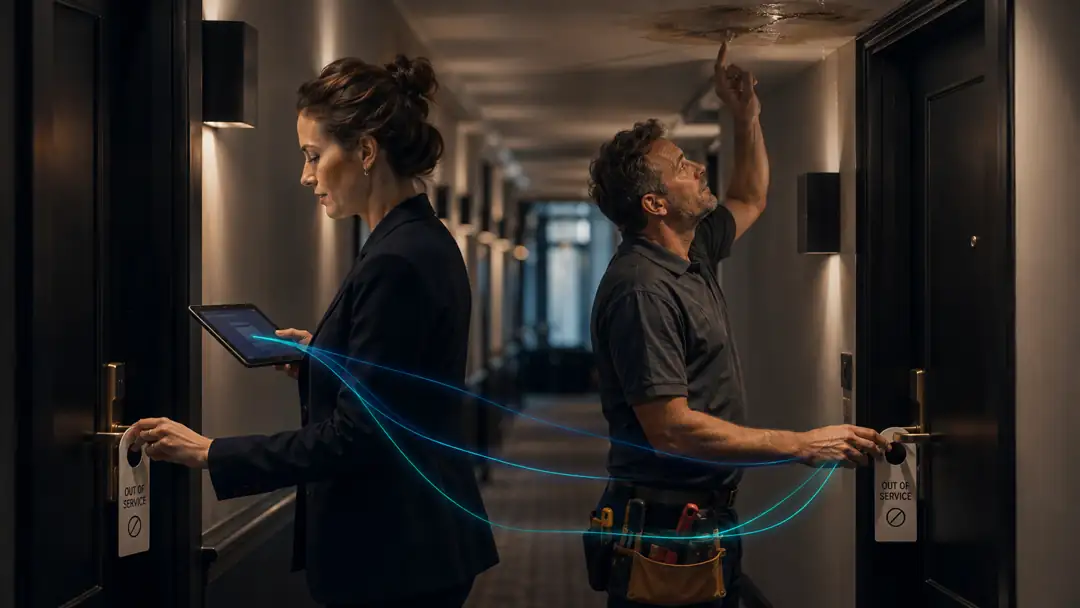
HospitalityCloses rooms for maintenance.Updates availability and operations.Explore the steps
Illustration for: Closes rooms for maintenance.
Illustrative scene

Person doing the work: Hotel manager

  1. Signal

    Closes rooms for maintenance.

  2. OPS context

    Updates availability and operations.

  3. Human authority

    The hotel manager confirms the rooms, maintenance reason and closure window before capacity is blocked.

  4. Bounded handoff

    CORE receives only the authorised capacity reduction and effective window; technical work notes stay in OPS.

  5. CORE record

    Versions capacity and blocks conflicts.

  6. Shared consequence

    All connected channels share sellable reality.

  7. Durable evidence

    The capacity record shows affected rooms, manager authority, start, end and every channel acknowledgement.

Intended result

All connected channels share sellable reality.

HospitalityChecks a guest in.Verifies booking, identity and deposit.Explore the steps
Illustration for: Checks a guest in.
Illustrative scene

Person doing the work: Receptionist

  1. Signal

    Checks a guest in.

  2. OPS context

    Verifies booking, identity and deposit.

  3. Human authority

    Reception confirms the matching booking, entitled guest, deposit status and room readiness before check-in.

  4. Bounded handoff

    Only the approved stay-start event and necessary service rights cross to CORE; identity documents remain protected in OPS.

  5. CORE record

    Marks the contracted stay as started.

  6. Shared consequence

    Access, services and billing become active.

  7. Durable evidence

    Check-in evidence binds receptionist, booking, room, deposit state, timestamp and activated services.

Intended result

Access, services and billing become active.

HospitalityReleases an inspected room.Completes task, media and deviations.Explore the steps
Illustration for: Releases an inspected room.
Illustrative scene

Person doing the work: Housekeeping

  1. Signal

    Releases an inspected room.

  2. OPS context

    Completes task, media and deviations.

  3. Human authority

    Housekeeping signs off inspection, readiness and any exception before the room returns to sellable capacity.

  4. Bounded handoff

    OPS shares the approved availability result with CORE; task detail, staff notes and unnecessary media stay local.

  5. CORE record

    Receives only the commercial availability result.

  6. Shared consequence

    The room can be assigned again.

  7. Durable evidence

    The release record keeps inspector, checklist version, exception status, room and effective release time.

Intended result

The room can be assigned again.

HospitalityA no-show passes the agreed threshold.Checks timing, contact and exceptions.Explore the steps
Illustration for: A no-show passes the agreed threshold.
Illustrative scene

Person doing the work: Hotel / guest

  1. Signal

    A no-show passes the agreed threshold.

  2. OPS context

    Checks timing, contact and exceptions.

  3. Human authority

    The hotel reviews arrival threshold, contact attempts, booking terms and valid exceptions before marking a no-show.

  4. Bounded handoff

    CORE receives the authorised no-show outcome, released capacity and financial rule; private contact content stays in OPS.

  5. CORE record

    Applies the visible no-show rule.

  6. Shared consequence

    Capacity and financial outcome update.

  7. Durable evidence

    Evidence retains the threshold, contact times, decision maker, applied term and resulting capacity and charge.

Intended result

Capacity and financial outcome update.

WarehouseScans an incoming pallet.Compares expected and received quantities.Explore the steps
Illustration for: Scans an incoming pallet.
Illustrative scene

Person doing the work: Receiver

  1. Signal

    Scans an incoming pallet.

  2. OPS context

    Compares expected and received quantities.

  3. Human authority

    The receiver confirms purchase reference, pallet identity, counted units, condition and exceptions before receipt.

  4. Bounded handoff

    OPS transfers the approved received quantities and custody state to CORE; dock notes and unrelated supplier data stay local.

  5. CORE record

    Confirms relevant ownership or custody.

  6. Shared consequence

    Only proven units become available.

  7. Durable evidence

    The receipt evidence binds scan, batch or serial, quantity, condition, receiver, location and ownership state.

Intended result

Only proven units become available.

WarehousePicks units for a sale.Guides route, batch and serial selection.Explore the steps
Illustration for: Picks units for a sale.
Illustrative scene

Person doing the work: Order picker

  1. Signal

    Picks units for a sale.

  2. OPS context

    Guides route, batch and serial selection.

  3. Human authority

    The picker confirms order, exact units, batch or serial and route completion before allocation is final.

  4. Bounded handoff

    CORE receives the approved unit allocation and sale reference; workforce telemetry and unrelated stock views do not cross.

  5. CORE record

    Allocates selected units to the transaction.

  6. Shared consequence

    The same stock cannot be promised twice.

  7. Durable evidence

    Allocation evidence keeps unit identity, source location, picker, time and the order that made it unavailable elsewhere.

Intended result

The same stock cannot be promised twice.

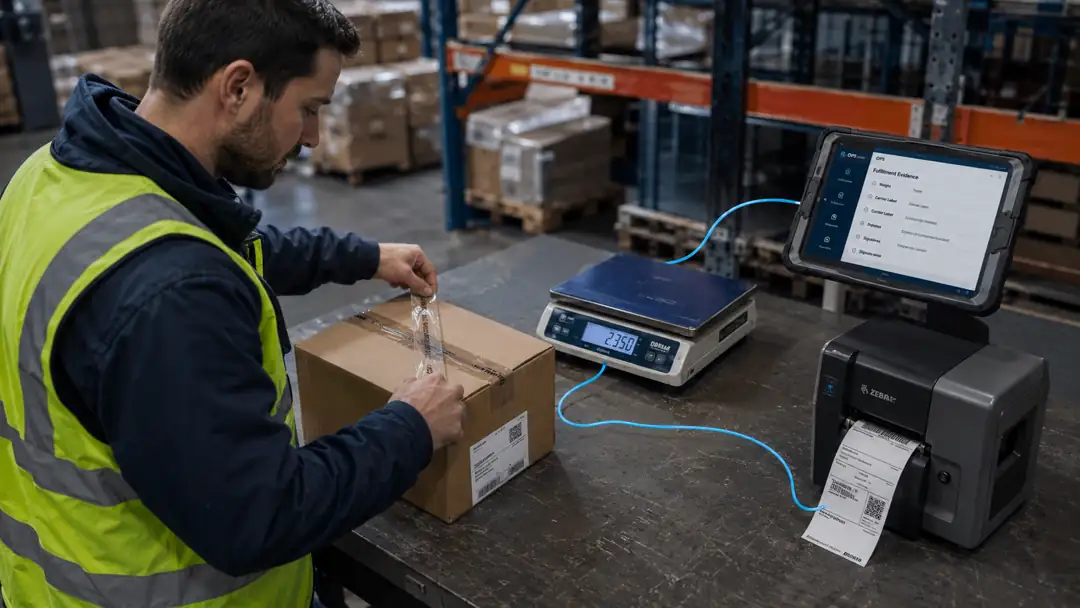
WarehouseSeals a parcel.Creates package, weight and carrier label.Explore the steps
Illustration for: Seals a parcel.
Illustrative scene

Person doing the work: Packer

  1. Signal

    Seals a parcel.

  2. OPS context

    Creates package, weight and carrier label.

  3. Human authority

    The packer confirms contents, package identity, weight, seal and carrier label before closing the parcel.

  4. Bounded handoff

    OPS hands CORE the approved package and fulfilment link; packing-station activity and unrelated orders remain local.

  5. CORE record

    Links fulfilment evidence to the promise.

  6. Shared consequence

    Buyer and seller share one shipment object.

  7. Durable evidence

    The parcel record preserves contents, weight, label version, seal, packer and promised destination.

Intended result

Buyer and seller share one shipment object.

WarehouseTakes the shipment at the dock.Records scan, route and vehicle context.Explore the steps
Illustration for: Takes the shipment at the dock.
Illustrative scene

Person doing the work: Carrier

  1. Signal

    Takes the shipment at the dock.

  2. OPS context

    Records scan, route and vehicle context.

  3. Human authority

    Warehouse and carrier confirm parcel set, dock scan, vehicle, route and exceptions before custody leaves the site.

  4. Bounded handoff

    Only the signed shipment handoff and service promise cross to CORE; internal dock operations remain in OPS.

  5. CORE record

    Records the commercial custody handoff.

  6. Shared consequence

    Responsibility moves to the right party.

  7. Durable evidence

    Handover evidence fixes both parties, parcels, scan, time, route and the moment liability changed.

Intended result

Responsibility moves to the right party.

WarehouseQuarantines damaged stock.Blocks location and starts inspection.Explore the steps
Illustration for: Quarantines damaged stock.
Illustrative scene

Person doing the work: Quality operator

  1. Signal

    Quarantines damaged stock.

  2. OPS context

    Blocks location and starts inspection.

  3. Human authority

    Quality control confirms affected units, observed damage, containment location and inspection owner before quarantine.

  4. Bounded handoff

    CORE receives the approved sellable-capacity reduction and quarantine scope; internal investigation remains in OPS.

  5. CORE record

    Removes units from sellable capacity.

  6. Shared consequence

    Channels stop before another customer is hit.

  7. Durable evidence

    The quarantine record preserves units, signal, inspector, reason, location and every channel capacity change.

Intended result

Channels stop before another customer is hit.

Marketplace & BiddingRegisters a design object.Builds media, origin, state and location file.Explore the steps
Illustration for: Registers a design object.
Illustrative scene

Person doing the work: VDC seller

  1. Signal

    Registers a design object.

  2. OPS context

    Builds media, origin, state and location file.

  3. Human authority

    The VDC seller confirms object identity, provenance, condition, media and sale terms before listing.

  4. Bounded handoff

    CORE receives the approved canonical object and versioned offer; drafts and private seller notes remain in OPS.

  5. CORE record

    Creates canonical object and versioned offer.

  6. Shared consequence

    QR, showroom and shop share one identity.

  7. Durable evidence

    Listing evidence binds owner, object, provenance, condition, media version, location and offer terms.

Intended result

QR, showroom and shop share one identity.

Marketplace & BiddingScans a VDC object QR.Shows story, status and valid actions.Explore the steps
Illustration for: Scans a VDC object QR.
Illustrative scene

Person doing the work: Visitor

  1. Signal

    Scans a VDC object QR.

  2. OPS context

    Shows story, status and valid actions.

  3. Human authority

    The visitor deliberately opens the object and chooses an available action after seeing current status and terms.

  4. Bounded handoff

    CORE returns only current offer truth and permitted actions; visitor identity is not promoted into a saleable profile.

  5. CORE record

    Returns current sale truth.

  6. Shared consequence

    Interest starts from an actual offer.

  7. Durable evidence

    The view evidence keeps object version, QR or route, offer status, time and the action selected next.

Intended result

Interest starts from an actual offer.

Marketplace & BiddingPlaces a bid.Checks identity and asks confirmation.Explore the steps
Illustration for: Places a bid.
Illustrative scene

Person doing the work: Bidder

  1. Signal

    Places a bid.

  2. OPS context

    Checks identity and asks confirmation.

  3. Human authority

    The bidder confirms amount, object, deadline and binding intent after identity and bid-step checks.

  4. Bounded handoff

    OPS submits only the signed bid payload and authority proof; strategy, drafts and unrelated financial context stay private.

  5. CORE record

    Validates time, order, step and authority atomically.

  6. Shared consequence

    No hidden overwrite can change bid order.

  7. Durable evidence

    Bid evidence preserves exact order, amount, object version, bidder authority, timestamp and rejection of conflicting writes.

Intended result

No hidden overwrite can change bid order.

Marketplace & BiddingCloses the bidding window.Stops input and presents provisional result.Explore the steps
Illustration for: Closes the bidding window.
Illustrative scene

Person doing the work: Auction engine

  1. Signal

    Closes the bidding window.

  2. OPS context

    Stops input and presents provisional result.

  3. Human authority

    The auction engine closes only after the configured deadline and rule set are confirmed against all valid bids.

  4. Bounded handoff

    CORE records the rule-bound provisional outcome; invalid attempts and private bidder context remain separated.

  5. CORE record

    Determines the valid winner by prior rule.

  6. Shared consequence

    Allocation can be explained.

  7. Durable evidence

    Closure evidence preserves rule version, deadline, ordered valid bids, winner calculation and operator oversight.

Intended result

Allocation can be explained.

Marketplace & BiddingReserves pickup with 30% deposit.Plans appointment and remaining actions.Explore the steps
Illustration for: Reserves pickup with 30% deposit.
Illustrative scene

Person doing the work: Buyer

  1. Signal

    Reserves pickup with 30% deposit.

  2. OPS context

    Plans appointment and remaining actions.

  3. Human authority

    The buyer confirms pickup window, deposit, remaining balance, transfer conditions and object identity before reservation.

  4. Bounded handoff

    OPS hands CORE the approved reservation, deposit position and pickup promise; negotiation history remains private.

  5. CORE record

    Separates deposit, remainder and transfer.

  6. Shared consequence

    Reservation does not silently equal ownership.

  7. Durable evidence

    Evidence distinguishes reservation from ownership and preserves deposit, balance, appointment, conditions and later handoff.

Intended result

Reservation does not silently equal ownership.

MY-HOUSEInvites a family member or manager.Shows roles and asks targeted consent.Explore the steps
Illustration for: Invites a family member or manager.
Illustrative scene

Person doing the work: Resident

  1. Signal

    Invites a family member or manager.

  2. OPS context

    Shows roles and asks targeted consent.

  3. Human authority

    The resident chooses the person, role, rooms or functions and validity window before granting house access.

  4. Bounded handoff

    Only the selected external right crosses to CORE; household conversations and unrelated private context stay inside OPS.

  5. CORE record

    Records the selected externally relevant right.

  6. Shared consequence

    Access exists at the correct scope.

  7. Durable evidence

    Access evidence keeps grantor, recipient, scope, start, expiry and every use or revocation of the right.

Intended result

Access exists at the correct scope.

MY-HOUSERequests a local maintenance service.Builds the request from conversation and photos.Explore the steps
Illustration for: Requests a local maintenance service.
Illustrative scene

Person doing the work: Home owner

  1. Signal

    Requests a local maintenance service.

  2. OPS context

    Builds the request from conversation and photos.

  3. Human authority

    The home owner confirms problem, property scope, photos, access conditions and request wording before seeking service.

  4. Bounded handoff

    OPS publishes only the approved service order to CORE; household conversation and unrelated home data remain private.

  5. CORE record

    Publishes an approved bounded service order.

  6. Shared consequence

    Provider can quote and fulfil.

  7. Durable evidence

    Service evidence links request version, approved scope, provider responses, appointment, custody and repair outcome.

Intended result

Provider can quote and fulfil.

MY-HOUSERents out an item, room or facility.Manages availability, conversation and handover.Explore the steps
Illustration for: Rents out an item, room or facility.
Illustrative scene

Person doing the work: Resident

  1. Signal

    Rents out an item, room or facility.

  2. OPS context

    Manages availability, conversation and handover.

  3. Human authority

    The resident confirms object or space, availability, price, deposit, handover and return conditions before booking.

  4. Bounded handoff

    CORE receives the approved rental promise and commercial terms; private household context and conversation remain in OPS.

  5. CORE record

    Records booking, payment, deposit and shared conditions.

  6. Shared consequence

    Both parties have one rental truth.

  7. Durable evidence

    Rental evidence preserves owner, renter, item or space, period, payment, deposit and both custody moments.

Intended result

Both parties have one rental truth.

MY-HOUSELends an object to another resident.Plans request, approval, pickup and return.Explore the steps
Illustration for: Lends an object to another resident.
Illustrative scene

Person doing the work: Neighbour

  1. Signal

    Lends an object to another resident.

  2. OPS context

    Plans request, approval, pickup and return.

  3. Human authority

    The owner confirms borrower, object, pickup, expected return and condition before agreeing the neighbour loan.

  4. Bounded handoff

    Only the agreed loan and custody moments enter CORE; private neighbour conversation stays in OPS.

  5. CORE record

    Records only the agreed loan and custody moments.

  6. Shared consequence

    Ownership remains clear while possession changes.

  7. Durable evidence

    Loan evidence keeps ownership, borrower, object identity, condition, pickup, return and any agreed exception.

Intended result

Ownership remains clear while possession changes.

MY-HOUSEBuys through a house affiliate assortment.Shows products in the chosen home context.Explore the steps
Illustration for: Buys through a house affiliate assortment.
Illustrative scene

Person doing the work: Resident

  1. Signal

    Buys through a house affiliate assortment.

  2. OPS context

    Shows products in the chosen home context.

  3. Human authority

    The resident confirms product, provider, price, delivery and affiliate disclosure before purchasing from the house context.

  4. Bounded handoff

    OPS sends the approved order and attribution to CORE; private household profile and unused recommendations do not cross.

  5. CORE record

    Records source, provider and affiliate allocation.

  6. Shared consequence

    Revenue is measurable without selling the private profile.

  7. Durable evidence

    Purchase evidence preserves source, provider, offer version, resident approval, fulfilment and affiliate allocation.

Intended result

Revenue is measurable without selling the private profile.

MY-HOUSEReturns keys and settles a deposit.Collects inspection, meter and handover result.Explore the steps
Illustration for: Returns keys and settles a deposit.
Illustrative scene

Person doing the work: Owner / renter

  1. Signal

    Returns keys and settles a deposit.

  2. OPS context

    Collects inspection, meter and handover result.

  3. Human authority

    Owner and renter confirm keys, inspection, meter readings, damage, obligations and deposit calculation before closure.

  4. Bounded handoff

    CORE receives the approved handover and settlement outcome; private discussion and unrelated tenancy context remain in OPS.

  5. CORE record

    Closes rental obligations and posts the settlement.

  6. Shared consequence

    Deposit release follows recorded evidence.

  7. Durable evidence

    Closure evidence binds both parties, inspection version, keys, readings, corrections, deposit release and final time.

Intended result

Deposit release follows recorded evidence.

Stad LierJoins the city marketplace.Collects profile, channels and verification.Explore the steps
Illustration for: Joins the city marketplace.
Illustrative scene

Person doing the work: Local merchant

  1. Signal

    Joins the city marketplace.

  2. OPS context

    Collects profile, channels and verification.

  3. Human authority

    The programme owner verifies merchant identity, location, channels, legal role and participation scope before activation.

  4. Bounded handoff

    CORE receives the approved merchant profile and participation rights; private verification material stays protected in OPS.

  5. CORE record

    Activates participation after authorised approval.

  6. Shared consequence

    Merchant gains reach without losing identity.

  7. Durable evidence

    Participation evidence preserves verifier, merchant version, approved channels, start date, obligations and later changes.

Intended result

Merchant gains reach without losing identity.

Stad LierBuys from two shops in one basket.Splits operational fulfilment.Explore the steps
Illustration for: Buys from two shops in one basket.
Illustrative scene

Person doing the work: Resident

  1. Signal

    Buys from two shops in one basket.

  2. OPS context

    Splits operational fulfilment.

  3. Human authority

    The resident confirms each shop, item, fulfilment promise and total before one city basket becomes two sales.

  4. Bounded handoff

    OPS hands CORE the approved split basket and payment allocation; browsing context and unchosen shops remain private.

  5. CORE record

    Creates two sales and one explainable payment.

  6. Shared consequence

    Each shop retains its own responsibility.

  7. Durable evidence

    Evidence keeps one customer confirmation while preserving separate sellers, stock, fulfilment, receipts and responsibility.

Intended result

Each shop retains its own responsibility.

Stad LierIssues a local purpose-bound voucher.Shows balance and eligible merchants.Explore the steps
Illustration for: Issues a local purpose-bound voucher.
Illustrative scene

Person doing the work: Programme owner

  1. Signal

    Issues a local purpose-bound voucher.

  2. OPS context

    Shows balance and eligible merchants.

  3. Human authority

    The programme owner confirms budget source, eligible audience, merchants, purpose, value and expiry before issuing vouchers.

  4. Bounded handoff

    CORE receives the authorised voucher rules and issued value; policy deliberation and personal eligibility evidence stay in OPS.

  5. CORE record

    Enforces validity, audience and spending rule.

  6. Shared consequence

    Public value follows its visible mandate.

  7. Durable evidence

    Voucher evidence preserves mandate, rule version, issue, redemption, remaining value and every rejected misuse.

Intended result

Public value follows its visible mandate.

Stad LierBooks access, table or participation.Manages guests and practical communication.Explore the steps
Illustration for: Books access, table or participation.
Illustrative scene

Person doing the work: Event visitor

  1. Signal

    Books access, table or participation.

  2. OPS context

    Manages guests and practical communication.

  3. Human authority

    The visitor confirms event, capacity right, party size, price and entry conditions before booking.

  4. Bounded handoff

    OPS transfers the approved reservation and entry right to CORE; guest conversation and unrelated city activity remain private.

  5. CORE record

    Records capacity, right, payment and entry.

  6. Shared consequence

    Venue and visitor share one reservation.

  7. Durable evidence

    Event evidence keeps capacity unit, booker, party size, payment, entry rule, issue time and later attendance.

Intended result

Venue and visitor share one reservation.

Stad LierBundles pickups from city sellers.Optimises route and scan order.Explore the steps
Illustration for: Bundles pickups from city sellers.
Illustrative scene

Person doing the work: Local carrier

  1. Signal

    Bundles pickups from city sellers.

  2. OPS context

    Optimises route and scan order.

  3. Human authority

    The local carrier confirms each pickup, seller promise, route order and vehicle capacity before bundling the run.

  4. Bounded handoff

    CORE receives separate custody promises inside the approved route; internal optimisation data and unrelated sales stay in OPS.

  5. CORE record

    Keeps custody promises separate per sale.

  6. Shared consequence

    Efficiency does not erase responsibility.

  7. Durable evidence

    Route evidence preserves every sale, pickup scan, custody holder, delivery promise and exception without merging responsibility.

Intended result

Efficiency does not erase responsibility.

GovernanceConfirms an exceptional discount.Shows reason, authority and expected impact.Explore the steps
Illustration for: Confirms an exceptional discount.
Illustrative scene

Person doing the work: Approver

  1. Signal

    Confirms an exceptional discount.

  2. OPS context

    Shows reason, authority and expected impact.

  3. Human authority

    The approver reviews reason, requested discount, authority ceiling and expected margin effect before confirming the exception.

  4. Bounded handoff

    OPS sends only the approved exception, scope and validity to CORE; deliberation and unrelated performance data stay private.

  5. CORE record

    Checks role, step-up and limit.

  6. Shared consequence

    Exception becomes valid and attributable.

  7. Durable evidence

    Exception evidence preserves requester, approver, role, limit, reason, affected transaction and expiry.

Intended result

Exception becomes valid and attributable.

GovernanceDivides a received payment.Shows expected outcome to operators.Explore the steps
Illustration for: Divides a received payment.
Illustrative scene

Person doing the work: Settlement engine

  1. Signal

    Divides a received payment.

  2. OPS context

    Shows expected outcome to operators.

  3. Human authority

    The settlement owner confirms the applicable agreement, received funds, taxes, fees, reserves and beneficiaries before posting.

  4. Bounded handoff

    CORE receives the authorised waterfall and source payment; internal forecasts and unrelated balances remain outside the handoff.

  5. CORE record

    Applies the valid waterfall.

  6. Shared consequence

    Each party gets a receipt and position.

  7. Durable evidence

    Settlement evidence keeps agreement version, calculation inputs, allocations, receipts, holds and later corrections.

Intended result

Each party gets a receipt and position.

GovernanceStarts a chargeback.Opens case and collects delivery evidence.Explore the steps
Illustration for: Starts a chargeback.
Illustrative scene

Person doing the work: Customer / payment provider

  1. Signal

    Starts a chargeback.

  2. OPS context

    Opens case and collects delivery evidence.

  3. Human authority

    The case owner verifies the chargeback source, disputed amount, delivery evidence, deadline and response authority before action.

  4. Bounded handoff

    OPS hands CORE the approved dispute state, affected settlement and counterproof references; private case discussion stays local.

  5. CORE record

    Freezes relevant settlement and links counterproof.

  6. Shared consequence

    Risk remains visible until resolution.

  7. Durable evidence

    Case evidence preserves claim, deadlines, frozen funds, submitted proof, provider decisions and final correction.

Intended result

Risk remains visible until resolution.

GovernanceRevokes an OPS connector.Stops future transfers while local work continues.Explore the steps
Illustration for: Revokes an OPS connector.
Illustrative scene

Person doing the work: Permanent Master

  1. Signal

    Revokes an OPS connector.

  2. OPS context

    Stops future transfers while local work continues.

  3. Human authority

    The Permanent Master confirms connector identity, revocation scope, effective time and continuity impact before withdrawal.

  4. Bounded handoff

    CORE receives the signed revocation and rejects future handoffs; each system keeps its local data and operations.

  5. CORE record

    Rejects new handoffs from that identity.

  6. Shared consequence

    Both systems remain operational.

  7. Durable evidence

    Revocation evidence preserves connector, authority, reason, time, last accepted message and every later rejection.

Intended result

Both systems remain operational.

GovernanceRequests one transaction evidence line.Shows only entitled operational context.Explore the steps
Illustration for: Requests one transaction evidence line.
Illustrative scene

Person doing the work: Auditor

  1. Signal

    Requests one transaction evidence line.

  2. OPS context

    Shows only entitled operational context.

  3. Human authority

    The auditor requests one defined evidence line and proves entitlement before any transaction detail is disclosed.

  4. Bounded handoff

    CORE returns only ordered events, decisions and versions within scope; unrelated private or operational context remains hidden.

  5. CORE record

    Returns events, decisions and versions in order.

  6. Shared consequence

    Outcome is explainable without full private access.

  7. Durable evidence

    The export itself records requester, legal or contractual basis, scope, source versions, issue time and checksum.

Intended result

Outcome is explainable without full private access.

YOUR NEXT STEP

Start with the work you want to make easier.

See plans and inclusions Explore OPS

This website adds no advertising or analytics tracking. Necessary account and security services may use their own cookies. The choice below remembers only that you have read this notice.

Only when you choose Understood, corporate_cookie_notice stores necessary-v1 for 180 days on this host, with SameSite=Lax and Secure on HTTPS. No optional categories are active.

Read the cookie policy